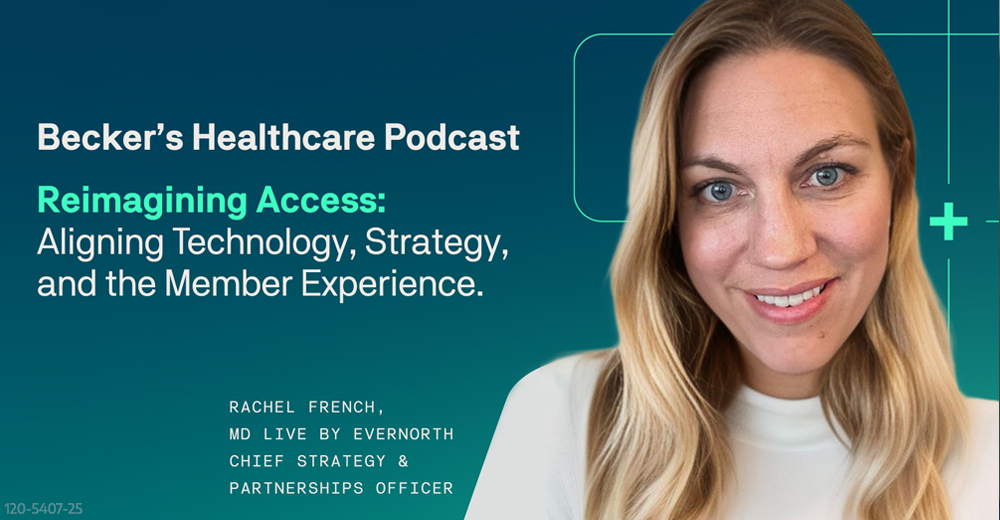
Reimagining Access: Aligning Technology, Strategy, and the Member Experience.
November 18, 2025
Tags
VIRTUAL CARE |
In this episode of the Becker's Healthcare podcast series, Rachel French, MD Live by Evernorth Chief Strategy & Partnerships Officer, examines the healthcare access challenges currently facing patients, plans, and providers. She further explains how the right technology, personalized approach, and a new perspective on delivering care can all lead to improved, reimagined access.
Reimagining Access: Aligning Technology, Strategy, and the Member Experience.
Transcript
Lukas Voss: Hi everyone, this is Lukas Voss with Becker's Healthcare. Thank you so much for tuning in to the Becker's Healthcare podcast series. Fantastic to have you. Today, we're talking reimagining access and aligning technology strategy with the member experience. I'm very excited to be joined by Rachel French, Chief Strategy and Partnerships Officer at MD Live by Evernorth. Rachel, it's so great to have you. Thanks for being here.
Rachel French: Thanks for having me today.
Lukas Voss: Absolutely. I want to start off for our audience with introductions, if you could just share a little bit about yourself, your work, and your journey in healthcare.
Rachel French: Absolutely. So my background is actually in public health and digital innovation. I've spent my career working across payers, providers, and tech organizations, with a mission to improve how care is delivered and experienced. What drew me to virtual care and to MD Live, more specifically, was the opportunity to address some of the most persistent challenges that we see in healthcare today, which are access and affordability. I myself was born and raised in a rural state, and I know firsthand the challenges of not having access to quality and affordable care. But now, as the Chief Strategy and Partnerships Officer at MD Live, I have the pleasure to continue to drive my personal passion along with the company mission forward. And for me, it's incredibly rewarding to be part of a team that is making healthcare better every day.
MD Live is an Evernorth Health Services company, and we are a leading provider of virtual care services, which includes primary care, urgent care, behavioral health, and dermatology. Nearly 63 million people have access to MD Live either through their health plan or employer benefits, and we have a national network of board-certified providers, including board-certified doctors and licensed therapists who are specifically trained in virtual care. We're dedicated to delivering accessible, personalized healthcare through a seamless digital platform, which we'll talk about more today.
Lukas Voss: Rachel, it's always so great to hear the rural perspective as someone who lives in Iowa. I absolutely understand. And you've mentioned some of the challenges, right? You've talked about these challenges. We talk about long wait times, appointments, availability, patient access. You talked about it remains one of the most persistent challenges for organizations right now. How are you thinking about redefining access in a way that's more sustainable and equitable for members?
Rachel French: Yeah, I think up until recently we've really thought about access primarily in terms of network design. And what I mean by that is the core question patients often ask, "Is my provider in network or out of network? Is the provider service covered by my insurance or not?"
But today, we're seeing a shift. Access really is no longer just about who's in network, it's also about how care is delivered. So that means thinking beyond traditional modalities, brick and mortar, but including virtual and asynchronous care. It's really about meeting members where they are, and that's beyond geography and making it easier for them to take the next best step in their care journey. That's only gotten increasingly complex.
Lukas Voss: At the end of the day, it is truly about patient care. How can we improve that step and make it as easy as possible so folks can receive the care that they deserve and that they need? Why is this more personalized connected care experience so crucial in this process?
Rachel French: It really comes down to that personalized and connected care is critical for engagement. You really have to think about how we can meet patients where they are so that we can provide the support for them to either take their first step in their care journey or continue on their journey to better health. And what I mean by that, or maybe a more specific example, is that at MD Live, we do this through our provider guided care programs. And an example I'll give you is through our provider guided weight management care plan specifically, which we offer as part of our virtual primary care solution.
Within these care plans, our providers work directly with our members to create an individualized care plan. These plans include clinical oversight, behavioral health support, and referrals. We also have tailored education that includes meal planning and exercise plans, all of which have a personalized goal set, not only with the patient, but in conjunction with their provider. Today we see so many solutions on the market that rely primarily on the technology piece alone. But at MD Live, we see firsthand how provider involvement is so critical to those sustained outcomes. And we see those today. We see members are losing weight, they're staying engaged, and they're feeling supported. It's all about making sure members aren't just receiving care, but they're actively participating in it with the right guidance every step of the way.
Lukas Voss: And you've mentioned something very important just now as well, and this, we've seen so much investment, such significant investments in digital point solutions to improve access. However, there's still a large number of members that struggle to get the care that they need. Where do you see that disconnect between payer strategies and member experiences, and how can organizations better align those two?
Rachel French: Yeah, so payers are continuing to invest in digital solutions at increasing rates, even more so since the pandemic. And they've done so to solve the access problem. But what's happening is now they're creating new issues or challenges. Members are experiencing more confusion, more fatigue, and ultimately ending up more disengaged because they're lost in all of the different offerings that they have.
They're overwhelmed by a hodgepodge of offerings that don't really feel connected, intuitive, or even easy to navigate. Many of the digital solutions really have dead ends and lack connectivity, and most importantly, don't have a clear call to action for that member to take for their next part of their care journey. So the answer really isn't more solutions. Payers need to move away from deploying some of these solutions in silos and instead towards designing a more personalized, holistic care experience that connects the dots for the members. And that's really the only way payers will ultimately be able to deliver on the promise of access.
Lukas Voss: What role does patient education play here in this context? How can leaders drive more effective engagement into all of these processes that you just mentioned?
Rachel French: One of the biggest barriers that we see is simply awareness. In fact, according to our own research that we've done, 70% of members who had MD Live didn't use it simply because they didn't know they had it. That's a huge, missed opportunity for both the member and the health plan. So the answer really relies in proactive guidance, meaning that we have personalized outreach so the member gets the information that feels relevant to them while also making referrals and care transitions seamless so that the next step in their care journey is clear.
When we take the burden off the patient to figure out what's available, when and how and where to use it, engagement goes up, outcomes improve, and the investment payers are making can start to deliver real value.
Lukas Voss: Yeah, the easier, the better. That's really a good way to go for the patient and for everybody really in the process. Looking ahead, how do you see technology shaping the next five years of healthcare access, really? And what are some of those innovations that you think will have the greatest impact on payer strategies and member experience?
Rachel French: We're going to continue to see the impact of two major forces. One: provider shortages. And two: an increasing number of consumers who do expect seamless unfettered access to care. And as clinics close, and we do have fewer providers available, virtual care isn't just a convenience anymore, it's an essential part of how care is delivered.
One of the more exciting things we're seeing is the potential of generative AI, and that's to help solve this supply demand equation using AI to help providers work more efficiently without replacing that personal touch. At MD Live, for example, I can speak to that AI. And we're using AI to reduce the administrative burden on providers, meaning that providers can spend less time on paperwork and more time with their patients. Of course, we always want to make sure that we're leveraging this powerful technology ethically and responsibly.
I also think we're going to see a shift towards more virtual first models where members begin their journey digitally, and technology will play a huge role in making that happen. Think of things like intelligently guiding patients, sharing data bilaterally, and connecting different sites of care to ensure that that continuity exists so members don't fall through the cracks.
Lukas Voss: Rachel, it's so fantastic to have you. We covered so many different aspects of this topic today. I want to thank you for your time and your insights and turn the floor over to you here too. Is there anything else that you want to mention to our audience that we might've not touched on that you think is important?
Rachel French: Yeah, I think the last thing I'll mention is innovation in healthcare, which we talk a lot about. We talk about how it's really in some ways easy to get caught up in the technology, on the tools and platforms and how they integrate and how they solve specific problems. And that's absolutely right. How we can leverage technology to advance healthcare. But oftentimes, we need to ensure we're not overlooking how critical the provider's role is in making these tools meaningful and helping patients understand and act on their health.
We're focused on innovating technology, but we're still centering our model on the patient-provider relationship. So when our providers are empowered with the right tools and data, patients feel more supported, and that's how we ultimately deliver on the promise of personalized and holistic care.