Making GLP-1s Work Harder:
5 Key Takeaways from MD Live and Welldoc
November 11, 2025

Tags
VIRTUAL CARE SOLUTIONS |
Weight management remains a critical health priority, with 40.1% of U.S. adults classified as obese.1 Obesity is a chronic condition that often comes with comorbidities like hypertension and diabetes, all of which can impact long-term health.
Effective weight management is in the best interest of patients and the healthcare industry, making it no surprise that 55% of U.S. adults want to lose weight.2 Yet, more than 50% of lost weight is regained within two years for many people, underscoring the need for sustained engagement and comprehensive support.3
Maggie Williams, MD, Senior Medical Director at MD Live by Evernorth, and Catherine Brown,
VP of Clinical Services at Welldoc, joined forces to explore this topic in the webinar, “The engagement advantage: Making GLP-1s work harder.”
Here are 5 key insights from the webinar you should know:
1. GLP-1s are powerful, but not a standalone solution.
GLP-1s have transformed the weight loss landscape, with spending growing 500% from 2018 to 2023.4 And these medications are effective, offering a mean body percentage reduction of 5.1%.5
But medication alone is rarely enough. Many people fall off, with GLP-1 persistence sliding to 32.3% at the one-year mark.6 On top of this, those with comorbidities or complex health needs may require additional provider oversight to avoid medication interactions or complications.
For long-term, sustained results, the ongoing support of trusted providers is essential.
- 4
https://www.ama-assn.org/public-health/prevention-wellness/spending-glp-1s-has-grown-dramatically-here-are-details
- 5
https://pmc.ncbi.nlm.nih.gov/articles/PMC11400221/
- 6
https://www.jmcp.org/doi/10.18553/jmcp.2024.23332#:~:text=4%2C066%20commercially%20insured%20obese%20members,%25%20switched%20GLP%2D1%20drugs.
2. Patient engagement is key.
Engaged patients, who are actively involved in their healthcare, are more likely to adhere to treatment plans and achieve better healthcare outcomes.7And, these patients often have improved healthcare outcomes as a result.8This engagement can often be the differentiator between short-term results and long-term success.
This engagement begins on the provider side and involves consistent interaction, accountability, and the use of effective digital tools.
3. Smoking cessation is a blueprint for lasting behavioral change.
Provider-guided models that foster behavioral change aren’t new. And they can drive real, long-term success. For proof, we look to tried-and-true smoking cessation models.
Only 3-5% successfully quit smoking without structured guidance.9 In contrast, models that combine behavioral therapy, pharmacological support, and community reinforcement yield dramatically higher success rates:
24% successfully quit smoking using behavioral and pharmacological treatment.
This same approach can be tailored to weight management, with providers offering coaching support, pharmaceuticals when it makes sense, and digital coaching for support. And, with the right technology, it can be delivered from anywhere.
- 9
https://pmc.ncbi.nlm.nih.gov/articles/PMC10858725/#sec2
4. Tech-powered, provider-guided care drives long-term outcomes.
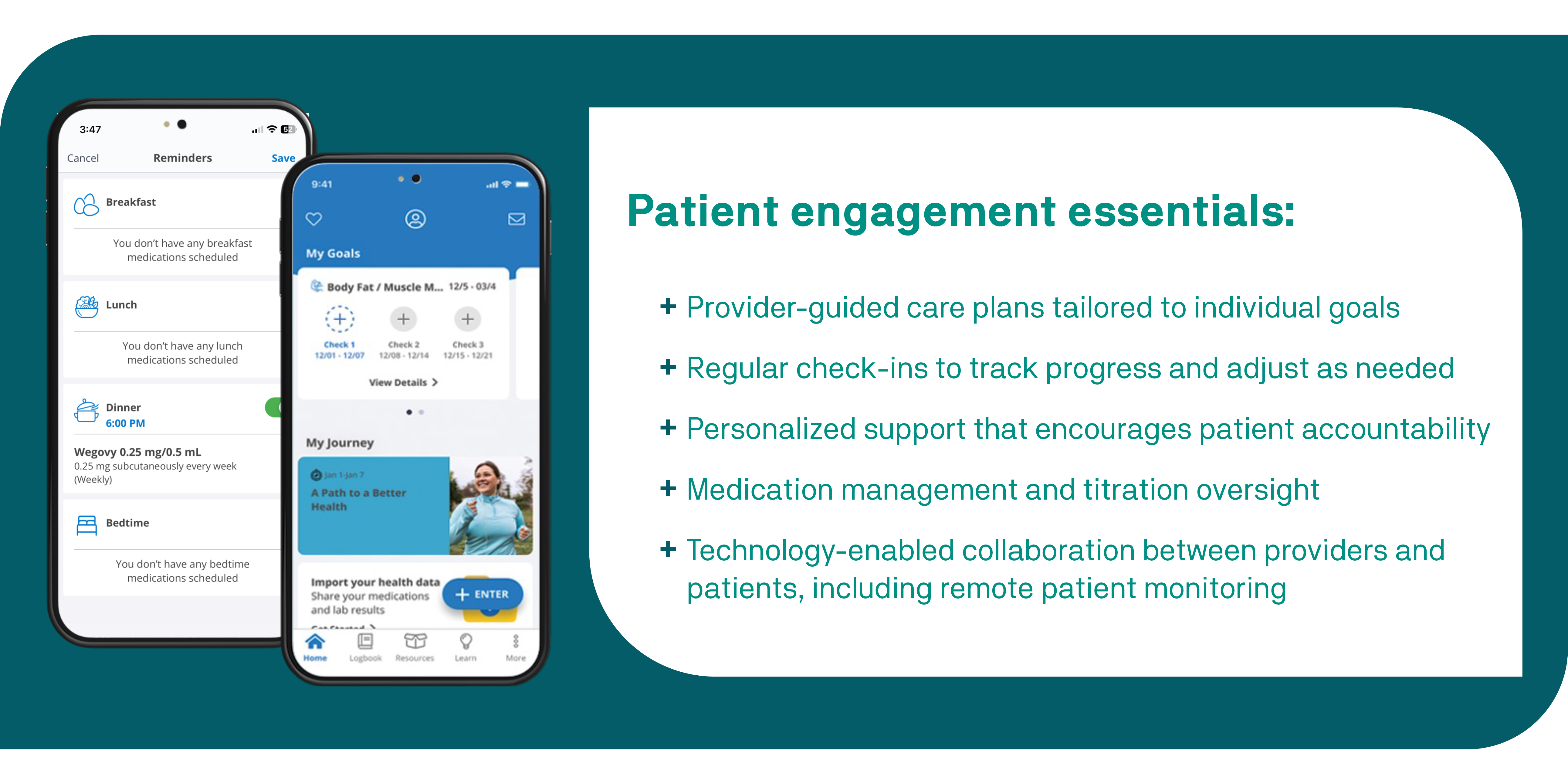
Where provider-guided care is foundational to a patient’s long-term success, technology can enable providers to deliver proper care while keeping patients accountable and engaged. Together, they can empower providers to deliver the right care at the right time.
But, how? With technology, providers can:
- Deliver personalized care plans that include medication management, lifestyle advice, and meal suggestions.
- Keep patients accountable and engaged through digital coaching, medication reminders, and provider-assigned goals.
- Utilize biometric data and digital touchpoints to make more informed decisions.
Most importantly, technology that incorporates the above features can enable the delivery of effective care, whether it’s digital or in-person. In fact, online coaching and intervention were found to be as effective as in-person coaching.10
- 10
https://showme.missouri.edu/2024/two-key-factors-for-online-weight-loss-success/
5. MD Live delivers real results.
The MD Live platform combines technology with provider-guided care, enabling real-world results for members:
MD Live Virtual Primary Care seamlessly combines provider-guided care with technology to keep patients engaged and supported throughout their care journey.
This offering includes:
- Board-certified obesity medicine specialists, lifestyle medicine specialists, and endocrinologists.
- Comprehensive treatment plans with digital coaching and lifestyle recommendations, along with FDA-approved medications and GLP-1s.
- Access to a rich library of workout videos and custom meal planning recommendations.
- Integration with the patient’s insurer and healthcare team, including on-demand formulary, real-time benefits checks, and in-network referrals.
- Care navigation support with outreach to coordinate care and support members in their health journey.
MD Live can also support behavioral health needs, including referrals to MD Live behavioral health specialists and integrated digital tools, such as journaling, guided action plans, and guided meditations. And upcoming features, such as GLP-1 side effect tracking and expanded behavioral health integrations, will further enhance outcomes and support long-term behavioral change.