Case study:
Care that meets people where they are.
How MD Live by Evernorth helped Teachers Health Trust improve access and meet population health needs.
May 11, 2026

Tags
| CASE STUDY HEALTH CARE ACCESS VIRTUAL CARE VIRTUAL CARE STRATEGY ASYNCHRONOUS CARE |
Simplifying the pathway to care.
Teachers Health Trust (THT) is a self‑funded, non-profit health plan serving educators and their families in Clark County, Nevada. Built “for teachers, by teachers,” THT is committed to simplifying healthcare and building a healthcare ecosystem that delivers real value.
Because educators have limited time and flexibility to seek care, THT has long focused on access, continuity, and getting members the right care at the right time. Since 2019, MD Live has played a growing strategic role in that effort—helping THT expand virtual access and improve member well-being.
Access to care: whenever, wherever.
When CEO Tom Zumtobel joined THT in 2021, the organization was navigating a significant financial and operational transition. Despite these pressures, THT remained focused on its core mission: ensuring educators continued to have access to care when and where they needed it.
MD Live played a critical role during this period, continuing to serve THT’s members without interruption while supporting THT through operational challenges. For educators with demanding schedules and limited flexibility for in‑person visits, MD Live remained a dependable, solutions‑oriented resource—helping THT maintain continuity of care during a pivotal moment.
Sustained engagement in a post-COVID-19 world.
During the COVID-19 pandemic, THT, like many other organizations, saw a sharp increase in virtual care utilization. But the more telling story was what came after. As in-person care became widely available again, utilization didn’t decline—it increased.
For THT, this demonstrated that its members trusted the MD Live experience and saw real value in it, especially educators who relied on after-hours and weekend access when care during the school day wasn’t feasible.
Expanding on a proven partnership with comprehensive care.
When it comes to vetting virtual care partners, THT prioritizes:
+ Access and convenience, especially for nontraditional schedules. + Member satisfaction. + Interoperability and continuity of care. |
This philosophy guided THT’s decision to expand its care offerings with MD Live, adding behavioral health, dermatology, and virtual primary care (VPC) in 2022. The ability for members to see the same provider, build relationships, and coordinate care across settings made VPC implementation a natural next step for THT.
With 70% of THT’s membership made up of women aged 40-55, having a virtual care solution that serves this population is critical. MD Live VPC capabilities have been able to address the preventive, hormonal, and ongoing care needs common among perimenopausal and postmenopausal women, reducing the need for THT to source and manage additional point solutions.
Plan design as a strategic lever.
THT’s decision to implement a $0 copay for virtual care was driven by one of its most deeply held beliefs: Financial barriers delay care and ultimately drive higher costs for both the member and the organization.
THT removed financial friction and focused on early access, prevention, and engagement. Combined with the elimination of high‑deductible plan barriers, this strategy has helped normalize virtual care as a first‑line care option for THT members.
Interoperability that drives impact.
THT’s broader wellness strategy includes a Health Investment Program (HIP) model, designed to support continuity of care, coordination across providers, and ongoing accountability. Through this model, THT prioritizes partners willing to operate within a connected care ecosystem rather than deliver care in isolation.
To participate as a Health Investment Provider, organizations are expected to:
+ Support EHR interoperability for real-time clinical data sharing. + Participate in post-visit satisfaction surveys. + Join monthly operational meetings focused on innovation and improvement. |
MD Live has embraced these expectations, reflecting our commitment to engaging beyond point-of-care delivery and working collaboratively with THT on access, continuity, and member experience over time.
Meeting educators where they are with after-hours access.
Utilization data has reinforced what THT already knew about their population: Educators often seek care in the afternoons, evenings, and on weekends. Leaving school midday for appointments often requires substitute coverage, which adds stress and makes traditional care models impractical.
Virtual care, especially asynchronous options, like MD Live E‑Treatment, allows members to access care quickly and discreetly, sometimes between classes, without stepping away for extended periods.
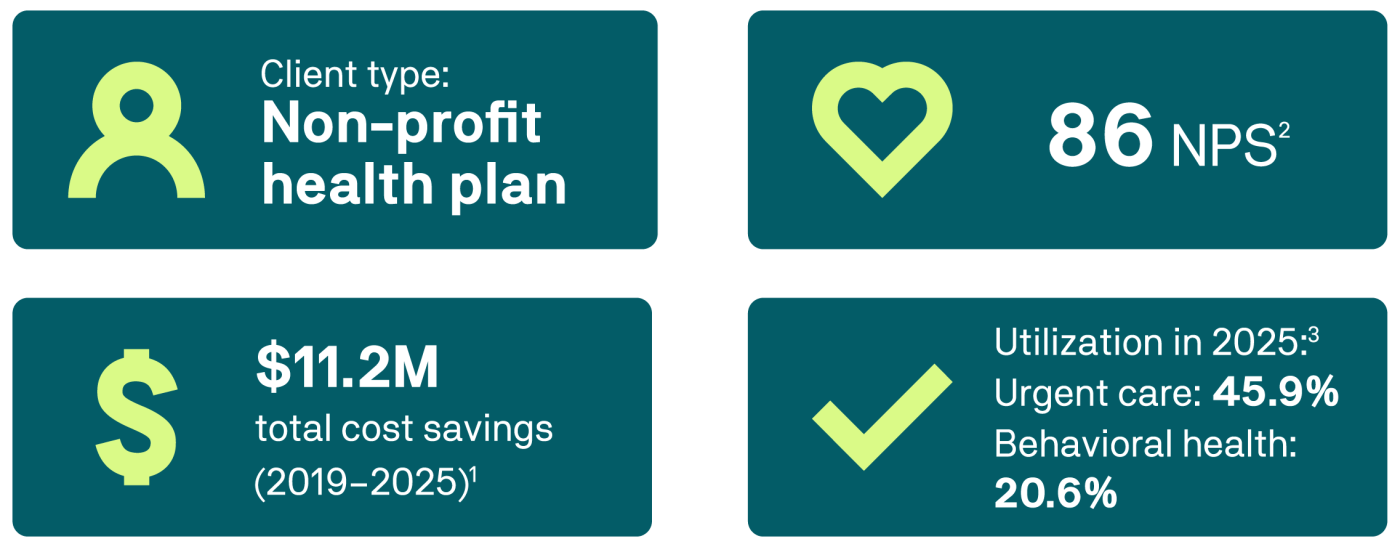
Over time, this convenience has translated into adoption: In 2025, utilization reached 45.9% for urgent care and 20.5% for behavioral health. And member feedback has been consistently positive, placing high value on getting care quickly, conveniently, and without disrupting the workday.
Beyond access: Sustained engagement in behavioral health.
Educators face especially high levels of stress, burnout, anxiety, and depression—and most are parents juggling caregiving responsibilities on top of that. Navigating the traditional behavioral health system can be overwhelming. Access to behavioral health care that’s fast, private, and doesn’t require leaving school during the day is more than just a nice benefit—it’s a critical one.
At THT, members aren’t just using MD Live Behavioral Health one time—they’re returning to it. In 2025, 81% of members who used MD Live Behavioral Health completed two or more visits, with an average wait time under 4 days to see a behavioral health specialist.
For THT leadership, sustained engagement is the clearest signal that the experience is working.

Lessons for health plans and employers.
Since partnering with MD Live, THT has experienced sustained utilization, strong member satisfaction, and improved financial performance, including $11.2M in cost savings from 2019–2025, an 86 Net Promoter Score (NPS) in 2025, and a medical cost trend of approximately 4% over the last three years. And all without increasing educators' premiums. These outcomes are a direct result of a benefits strategy built around one core principle: Make it as easy as possible for members to get the right care at the right time.
THT’s experience offers clear guidance for organizations looking to replicate these results:


For employers and health plans navigating rising costs, workforce burnout, and increasing demand for flexibility, THT’s approach offers a clear lesson: When access is reliable, care is integrated, and barriers are removed, virtual care becomes a powerful driver of member well-being and long-term financial sustainability.